

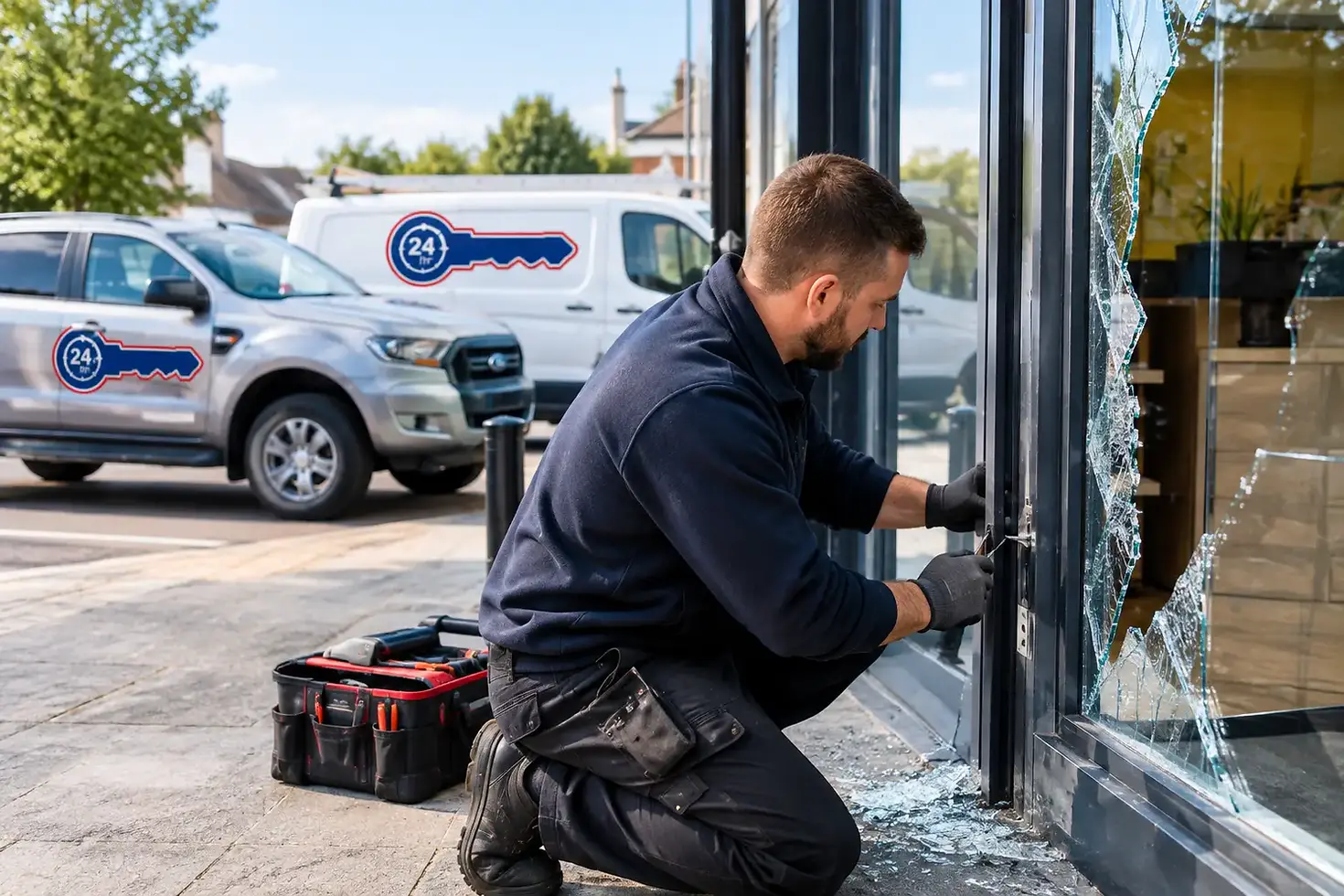
A Shopfront Break In Repair Example Explained

A shopfront break in repair example is most useful when it shows what happens in the first few hours after forced entry, not just the finished result. A damaged shopfront can leave stock exposed, staff shaken and the business unable to open safely. The priority is to secure the premises quickly, preserve evidence where required and put the right repair in place so the problem does not become a repeat incident.
Shopfront break in repair example: a typical urgent call-out
Imagine a Gloucester retailer arriving early to find that an intruder has forced the lower section of an aluminium-framed glazed door. The lock has been attacked, the glass panel is cracked and the door will no longer close into the frame. There is no safe way to leave the entrance unattended.
Before arranging repairs, the business owner checks that nobody is inside and contacts the police if the break-in has just happened or evidence may still be needed. Once the premises are cleared for access, an emergency locksmith attends to assess the door, lock, frame and glazing risk.
On arrival, the first job is not necessarily fitting a new lock. If broken glass, a bent frame or a damaged closer prevents the door from shutting properly, the entrance must be stabilised first. The locksmith makes the area safe, checks whether the door can be closed without creating further damage and establishes whether an emergency board-up is needed.
In this example, the door has been levered near the locking point. The original lock cylinder is damaged and the internal mechanism has been put under strain, but the aluminium frame is still sound. The cracked glazed panel remains in place but is unsafe to rely on overnight. The practical response is to remove the failed lock, secure the opening with a temporary board-up and fit a replacement lock where the door can accept one safely.
This gives the owner a secure, controlled premises while the correct replacement glass is measured and ordered. It also avoids forcing a permanent repair onto damaged hardware before the full condition of the door is known.
What a proper repair should address
A quick board-up is essential where there is an open or vulnerable entrance, but it is only the first stage. A shopfront repair needs to deal with the point of attack as well as the visible damage. Otherwise, the business may be left with a new pane of glass but the same weak lock, misaligned door or poor closing action.
Securing the opening straight away
The emergency measure depends on the shopfront construction. A fully shattered pane, a loose glass panel or a door that will not latch normally needs immediate protection. Boarding is often the sensible choice overnight, particularly if a specialist glazing repair cannot be completed at the first attendance.
Where the door can be shut and locked securely, a temporary repair may be enough until parts arrive. It depends on the condition of the frame, hinges, closer and locking points. Safety comes before appearance at this stage, but the premises should still be left weather-resistant and difficult to force open.
Repairing the lock and door mechanism
A forced door is rarely just a lock replacement. The locksmith checks the lock case, cylinder, handles, keeps, hinges and alignment. On commercial aluminium doors, the internal mechanism may have been damaged by the same force that snapped or twisted the external lock.
If the door has dropped or the frame has moved, simply fitting a new cylinder may make the lock stiff, unreliable or prone to early failure. Adjusting the door and restoring correct engagement with the keeps helps the new lock work as intended.
The replacement should be appropriate for the door and the level of risk. British Standard and anti-snap approved parts can be a sensible option where compatible, particularly for premises with insurer requirements. The exact specification depends on the existing door system and whether the lock is part of a wider master key or restricted key arrangement.
Replacing damaged glazing properly
Glass replacement should match the shopfront's required specification. A pane that looks similar is not always suitable. Toughened or laminated safety glass may be required depending on the panel location and the original installation.
The glazing contractor will normally need accurate measurements once the opening is stable. In the meantime, a professionally fitted board-up protects the business from weather, opportunist entry and accidental injury. It also allows the owner to reopen safely where the rest of the entrance remains usable.
Checking closing and escape arrangements
A commercial door must work correctly from both sides. After emergency work, it is vital to check that staff can leave the premises without obstruction and that the door closes and secures properly afterwards. This matters especially where a shopfront entrance forms part of an escape route.
Do not accept a repair that leaves a door needing excessive force to open, held shut by an improvised method or unable to latch. These shortcuts can create safety issues and lead to further damage to the mechanism.
The difference between an emergency fix and a permanent repair
A business owner understandably wants the premises to look normal again as soon as possible. Yet the fastest first response is sometimes a secure temporary measure followed by a scheduled permanent repair. This is common when glazing is damaged, a specialist door mechanism is required or the frame needs attention before new hardware is fitted.
The key question is whether the shop can be left secure and operate safely. If it can, temporary boarding and a replacement lock may allow trading to continue while the final glazing work is arranged. If the entrance cannot be secured or used safely, the priority is making it safe until the full repair is complete.
A good emergency locksmith explains that distinction clearly. You should know what has been fixed on the day, what remains temporary, which parts have been ordered and whether any further visit is needed. That clarity is particularly helpful for landlords, managing agents and business owners handling an insurance claim.
Evidence, insurance and practical next steps
After a break-in, take clear photographs before debris is cleared where this is safe to do. Record damage to the door, locks, shutters, shopfront glass and nearby property. Keep any details provided by the police, then notify your insurer in line with your policy conditions.
Ask for an itemised record of the emergency attendance and the work completed. It should distinguish between securing the premises, lock repairs, boarding and any follow-on work such as glazing or door adjustment. This makes it easier to understand costs and provide the right information to insurers or property managers.
Avoid repeatedly testing a damaged door or trying to force a stiff lock. A mechanism that has been attacked can fail completely with further use, leaving staff unable to secure the premises. Keep the entrance supervised if it cannot be locked reliably until professional help arrives.
Reducing the chance of a repeat break-in
Once the immediate repair is complete, it is worth reviewing how the intruder gained entry. The answer may be an upgraded cylinder, stronger handles, improved door alignment or a repair to weak keeps in the frame. In some cases, the issue is not the lock itself but a poorly maintained door that was already hard to close.
For premises with multiple staff, consider who holds access authority and whether former occupants or contractors may still have access. Restricted key systems and master key arrangements can offer better control where appropriate, while key safes may help manage authorised out-of-hours entry without leaving spare keys in insecure places.
Lighting, alarms and shutter condition may also form part of the wider security picture. There is no single upgrade that suits every shop. A small independent retailer, a managed block and a public-facing office all have different risks, budgets and insurance conditions.
The most useful outcome from any shopfront break-in is not simply a boarded opening or a replaced lock. It is a premises that closes properly, meets the required security standard and gives the owner confidence to leave at the end of the day. If anything still feels loose, stiff or temporary after the emergency visit, have it checked before it becomes the next point of failure.


Comments